Notre Dame researchers unveil innovative system for studying the impact of climate change on streams
The system, which will enable new ecological experiments, was designed with the environment, education, and society in mind.

Earth owes its nickname “The Blue Planet” to the seas and oceans that cover over 70% of its surface. And yet, for most people, it is Earth's smaller freshwater sources that serve their daily needs. Over half of the world’s population lives within two miles of a river or stream. These replenish aquifers and deliver water for drinking, washing, irrigation, and other purposes.
Scientists know that climate change poses a significant threat to the world's freshwater, including rivers and streams. A few degrees of warming can upset their balance and can lead to blooms of toxic algae, contamination from disease-carrying pathogens, a rise in invasive species, and other serious problems.
However, predicting and controlling changes in freshwater ecosystems can prove challenging. Jennifer Tank, the Galla Professor of Biological Sciences at the University of Notre Dame, explains, "The impact of temperature changes on streams and rivers is not well understood. Researchers need an experimental setting that closely resembles natural conditions but also includes a way to manipulate water temperatures."

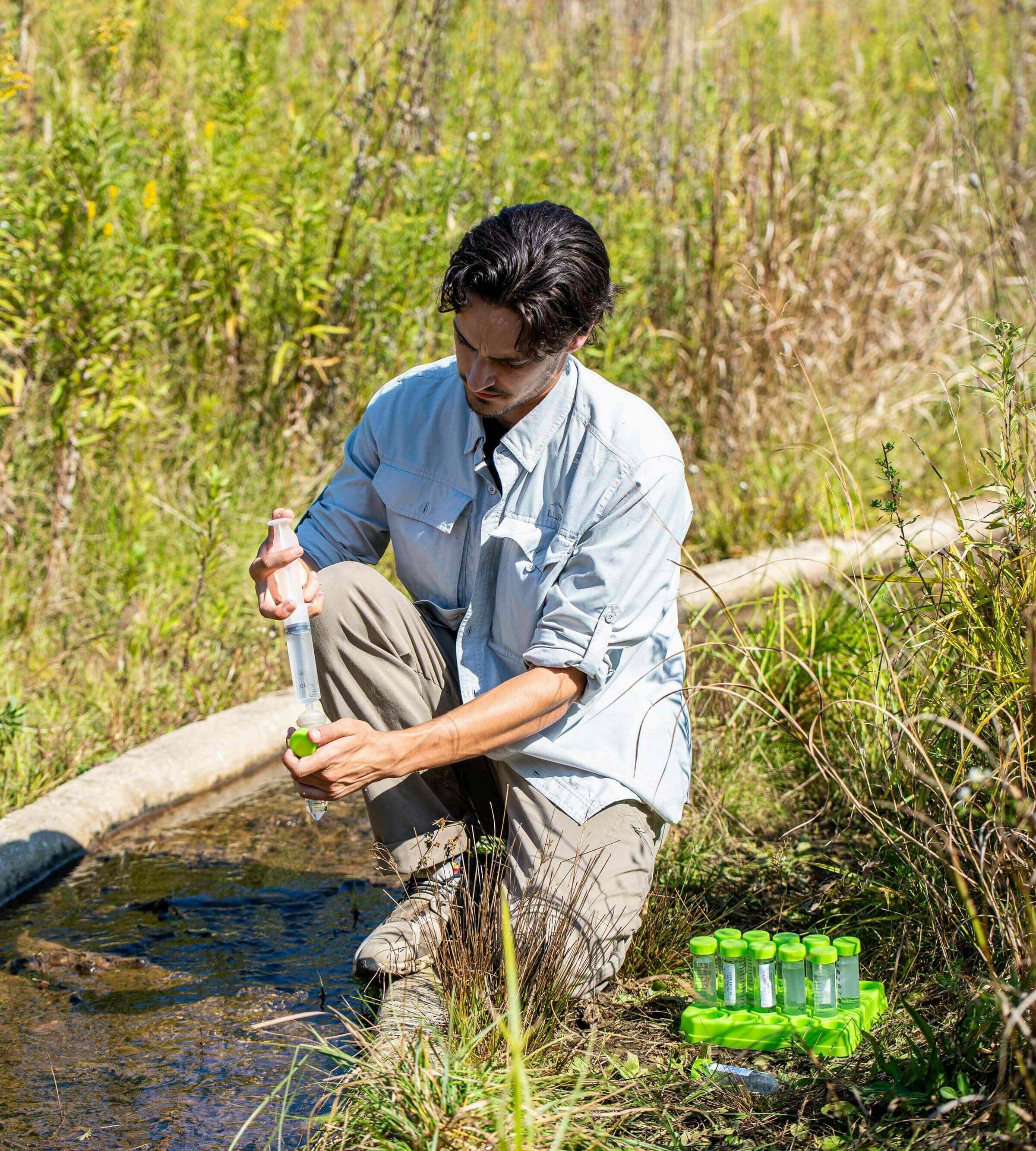
To fill the gap in scientific understanding, Tank and her colleagues at Notre Dame's Environmental Change Initiative (ND-ECI) have added a crucial new capability to the Notre Dame Linked Experimental Ecosystem Facility (ND-LEEF) called the Linked Experimental Temperature System (ND-LEEF-LETS).
ND-LEEF is the University’s specially designed research ecosystem located at St. Patrick’s County Park, just north of Notre Dame’s campus on the Indiana-Michigan border. The addition of the ND-LEEF-LETS system was made possible by a generous gift from JoJo Gehl Neumann ‘93.
Brett Peters, ND-LEEF’s Assistant Director, explains, “The power of ND-LEEF lies in its ability to mimic real-world conditions while allowing researchers to manipulate variables, much like in a lab setting. This hybrid approach provides insights into how ecosystems might respond to climate changes in the wild. The new ND-LEEF-LETS infrastructure takes those capabilities to the next level by adding a sophisticated system for temperature control.”
The key innovation behind ND-LEEF-LETS is its unique use of heat pump technology. Although heat pumps have existed for several decades, they have emerged as a key technology for sustainable temperature change because they transfer heat instead of creating heat by burning fossil fuels or creating electrical resistance.

The heat pump at ND-LEEF-LETS uses one sixth of the energy consumed by more conventional heating methods. It is able to orchestrate an exchange of heat between the four streams at ND-LEEF-LETS. Drawing heat from two streams cools them while heating the other two streams simultaneously, making temperature changes quick and energy-efficient.
The facility also includes a newly installed solar panel array for generating electricity. This addition enables the facility to operate a net-zero energy usage by producing as much energy annually as it consumes. The solar panels were produced by Crossroads Solar, a South Bend-based company that employs formerly incarcerated individuals, ensuring that the facility has a positive impact not just on the environment but also on the local community.
In addition to the new scientific findings the system will enable, it will also create new education opportunities for visitors to the facility. Area residents will now learn about sustainable technologies and environmental science at the same time through field trips, the annual Science Sunday event, and other activities that promote learning for all ages.
Tank explains, "This new system not only advances research using a one-of-its-kind experimental platform, but ND-LEEF-LETS also embodies a commitment to sustainability and social responsibility. By working with local organizations and involving students, we’re making a positive impact on both the scientific community and the broader public."

Although ND-LEEF-LETS is still in its first year of operation, experiments conducted on site have already begun to yield discoveries. Researchers have gained new insights into how temperature changes affect stream biology, including the ability of organisms to process carbon and nutrients.
With its proof-of-concept phase complete, the facility is now open for use by additional researchers. Peters notes, “This is a fantastic opportunity for testing new ideas in stream ecology. We invite faculty from Notre Dame and other universities around the country to take advantage of the unique capabilities ND-LEEF-LETS has to offer.”

Contact:
Brett Beasley / Research Content Strategy Program Director
Notre Dame Research / University of Notre Dame
bbeasle1@nd.edu / +1 574-631-8183
research.nd.edu / @UNDResearch
About Notre Dame Research:
The University of Notre Dame is a private research and teaching university inspired by its Catholic mission. Located in South Bend, Indiana, its researchers are advancing human understanding through research, scholarship, education, and creative endeavor in order to be a repository for knowledge and a powerful means for doing good in the world. For more information, please visit the website or @UNDResearch.
Photography: Angelic Rose Hubert
Aerial Photography and Videography: Emily Wedel
