Students, faculty, and community partners from various colleges and professions recently gathered at the Morris Inn’s Smith Ballroom for the annual Global Health Day Symposium, hosted by the Eck Institute for Global Health at the University of Notre Dame. This year’s theme, “Responding to Global Health Security Threats: Building Capacity and Resilience in a Connected World,” fueled discussions and dialogue about the multi-disciplinary collaboration needed to address the challenges and opportunities in global health security.
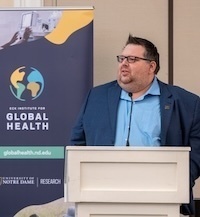
Jeffrey F. Rhoads, John and Catherine Martin Family Vice President for Research at the University of Notre Dame, and professor of aerospace and mechanical engineering, provided opening remarks for the event. “The [COVID-19] pandemic brought many lessons. It showed us that health is not local, a threat anywhere can become a crisis everywhere, and that preparedness is not just about science. It’s about systems, trust, and leadership. And perhaps most importantly, it reminded us that our vulnerabilities are shared—and so is our responsibility,” he said.
Rhoads also challenged the audience to explore tough topics and ask tough questions. "I encourage you all to continue to forge partnerships, push boundaries, and explore what we can do together, because I'm confident that the next global health security crisis will test what we build today. So, let's make sure we build it together through collaboration.”
Panel Discussion
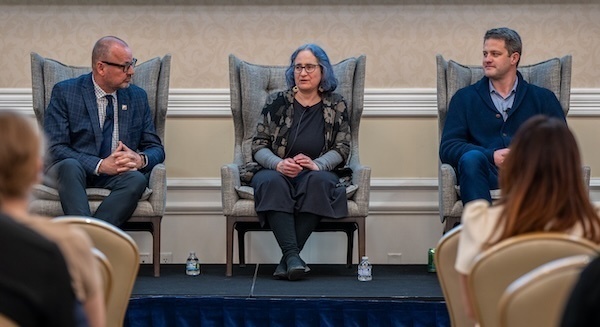
Kicking off the afternoon was the panel discussion moderated by Bernard Nahlen, director of the Eck Institute for Global Health and professor of biological sciences. “Global health security is about our ability to prevent, detect, and respond to infectious disease threats,” said Nahlen. “It's also about whether we are prepared across disciplines, institutions, and borders to act together where it matters most. Across Notre Dame, that work is already underway.”
The panel featured perspectives from three faculty researchers with diverse experiences in global health security issues:
- Kyle Bibby - Associate Department Chair and professor of civil and environmental engineering and earth sciences
- Marya Lieberman - Nancy Dee Professor of Cancer Research, Department of Chemistry and Biochemistry
-
Jarek Nabrzyski - Associate Vice President for Research for Special Initiatives; Senior Advisor and Director Emeritus, Center for Research Computing
Titled “From Research Excellence to Global Impact: Notre Dame Advancing Health & Well-Being Through Global Health Security,” the panelists discussed how their specific research addresses global health security concerns, the inherent challenges in working with resource-limited locations, and the importance of working together across disciplines.
Nabrzyski started the panel discussion by emphasizing this point: “Global health security is by definition multidisciplinary. We cannot model, detect, or contain these threats through any single discipline. Zoonotic pathogens sit at the intersection of ecology, genomics, epidemiology, veterinary science, computational science, and decision science — you often need four, five, or six disciplines working in concert to solve a single problem.”
An example was his team’s work with REDI-Net led by Notre Dame researchers. This DoD-funded surveillance program led by Nicole Achee and John Grieco, both research professors in biological sciences, is designed to detect emerging zoonotic diseases before they become outbreaks. “The biology anchors it, but the project only becomes actionable when layered with field collection, genomic sequencing, AI-driven analysis pipelines, secure data infrastructure, and risk visualization for decision-makers,” he said. “None of that happens without disciplines learning each other's vocabulary and working as one team. We encourage our research software engineers to take classes in the domains they support. On REDI-Net, that meant biology. When everyone shares the vocabulary, the team stops working in parallel and starts working together.”
“We have really focused on getting actionable information to people at the right time and the right place,” said Lieberman. “I've learned that I have to get out of my academic bubble. …And often, I find that the problem that I think is the problem, isn't really the problem.”
She continued, “I had not thought that cancer drugs would be subject to being faked, because their quality is so important for care outcomes. Through my work in sub-Saharan Africa, I realized, if people are faking antibiotics, they're going to also be faking these other products. It's not just an analytical chemistry problem. It's a supply chain security problem. It's an information-sharing problem.”
In speaking about his current research, Bibby began, "If you get sick with an infectious disease, you shed markers of that disease in feces, urine, saliva that winds up in wastewater. If we think about where we actually want to look for those markers, it's probably on the front lines where some of these diseases are most likely to emerge, and that's quite a challenging environment. So I think developing tools to enable pathogen surveillance in a more resource-limited setting is something that we're continuing to develop.”
The panelists agreed that sensor technology, predictive tools, artificial intelligence, and the number of global partnerships developed by the Notre Dame community impact global health security and the ability to meet needs where they are.
Keynote Speaker
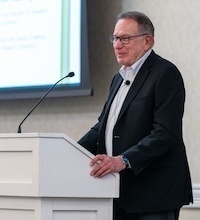
Next, the program welcomed featured keynote speaker, Ambassador Mark A. Green (retired), former administrator of the US Agency for International Development (USAID) and former US Ambassador to Tanzania. Speaking to his theme, “Why Our Global Health Leadership Matters: Stories from the Field,” he shared some of his experiences in Tanzania.

He noted that 2025 was the most significant year for international development in a generation. “A lot of people have dedicated their lives and careers to global health, international development, and humanitarian relief and have been shaken by what has gone on,” he said. “So in 2026 and 2027, that's when we have to answer the question, ‘Is trade, not aid, an excuse to do less with less?’ Or is it a down payment on a new system, a new framework that's innovative?”
He went on to describe that much has changed since the affected programs were created. First, technology has facilitated the daily emergence of new medicines and treatments, as well as the use of mobile phones, civilian drones, 3D printers, and more in remote parts of the world: “AI is diagnosing diseases remotely in places that doctors can't visit often enough.”
“Another big change is how much the world's human landscape has changed,” he said. He noted that 70 percent of Africans are under the age of 30, and in the world today, 120 million people have been forcibly displaced from their homes. “How do these families access care? How do we detect and prevent communicable diseases? How do we turn back outbreaks? How can we reach these unfortunate people who have been forced to move? ”
And finally, he explained that there are 32 countries in Africa that pay more in debt service than they do in health. “That's a challenge,” Green said. “Debt is crushing them and limiting their [financial] ability.”
“So, as we gather here on this beautiful campus … we have work to do,” he said. “What we have to do in this new framework is go much further. We have to help them, so they don't have to ask for food, grain, or meds again. That's how that capacity gets built. It's a challenge to all of us, but it's also an opportunity for us to shape what goes forward.”
Recordings of both presentations are currently available on the Eck Institute for Global Health’s Global Health Day 2026 event webpage.
Awards and Recognition Ceremony
The afternoon’s symposium concluded with an awards ceremony that recognized various achievements in global health.

Graduating senior Meera Bhakta ('26, Preprofessional Studies) was recognized with the Global Health Exemplar Award for her depth and breadth of research and work in global health while a student at Notre Dame. Her significant research achievements included:
- Research that addressed one of the most complex challenges in maternal health in India: Why high-risk women elect home delivery despite elevated clinical risk.
- An Ethics Research Fellowship award by the Institute for Ethics and the Common Good for her pivotal role in evaluating a psychosocial breast cancer support group in Harar, Ethiopia.
- Publication of her research in a peer-reviewed journal, Supportive Care in Cancer, for her 2024 collaboration with the Hiwot Fana Cancer Treatment Center in Ethiopia.
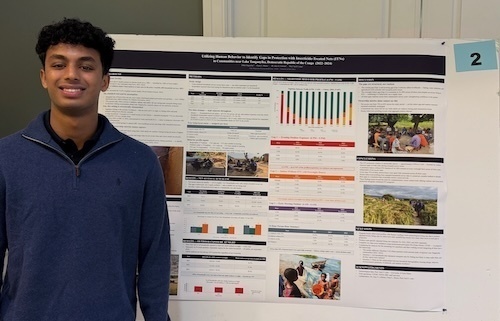
The Best Undergraduate Student Research Poster, out of 12 presented, was awarded to Ethan Augustine (‘26, Preprofessional Studies) for his research titled, “Utilizing Human Behavior to Identify Gaps in Protection with Insecticide-Treated Nets (ITNs) in Communities near Lake Tanganyika, Democratic Republic of the Congo (2022–2024).”
A total of 31 research posters by graduate students and postdoctoral scholars were presented, and the Best Graduate Student Research Poster was awarded to two winners:
- Henry Kamugisha (Ph.D. Student, Biological Sciences) for his research titled, “High-density subclinical P. malariae and P. ovale infections occur almost exclusively among high-density P. falciparum carriers in western Kenya.”
- Nahom Mulatu (‘26, MS Global Health) for his research titled, “Performance of a Rapid Antigen Detection Test and Clinical Decision Rules for Diagnosing Group A Streptococcal Pharyngitis in Ethiopia.”

The Best Photo in the Global Health Day Photo Contest was awarded to Erin Kong (‘28, Neuroscience and Behavior; Anthropology) for her image titled, “Silence After.” The description that accompanied her photo reads: “The dentist’s room sits serenely after a loud and painful extraction. Just before, two children endured the removal of decaying teeth. Without restorative resources, extraction remained the only option. The teeth rest wrapped in simple paper napkins taken from the dining room. The stillness contrasts with the urgency that preceded it.” A total of 27 photos depicting various topics in global health were submitted by undergraduate and graduate students.
To learn more about Global Health Day, hosted each year by the Eck Institute for Global Health at the University of Notre Dame, please visit the Symposium’s website: https://globalhealth.nd.edu/education/student-opportunities/global-health-day-symposium/
Contact:
Damienne Jugovic, Research Communications Specialist
Notre Dame Research / University of Notre Dame
djugovic@nd.edu
research.nd.edu / @UNDResearch
About the Eck Institute for Global Health
The Eck Institute for Global Health, an integral part of Notre Dame Research, builds on the University’s historical strength in infectious disease research, including vector-borne diseases, while broadening the interdisciplinary expertise into other key global health areas including non-communicable diseases; maternal, newborn, and child health (MNCH); and global health security. The Eck Institute recognizes health as a fundamental human right and promotes research, training, and service to advance health standards and reduce health disparities, especially for those who are disproportionately impacted by preventable diseases. The Eck Institute is training the next generation of global health researchers and leaders through undergraduate, graduate, doctoral, and postdoctoral programs.
Photo Gallery



Originally published by at globalhealth.nd.edu on April 28, 2026.