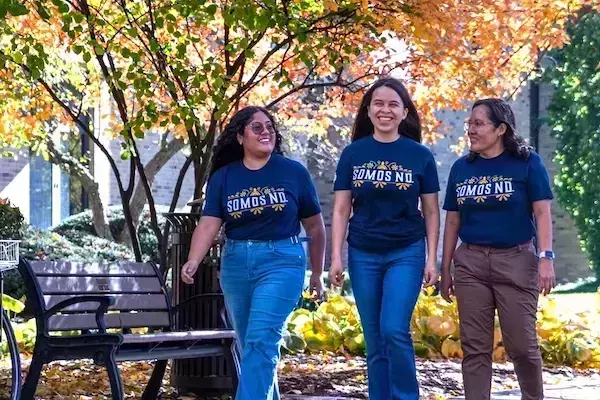
In the 1850s, the University of Notre Dame welcomed its first international student from Mexico and thus began a long tradition of binational exchange. Today, the Eck Institute for Global Health at Notre Dame is deepening this commitment to reciprocal partnerships with the creation of a new initiative that streamlines student exchanges and support. These efforts recently paved the way to host three visiting graduate students from Mexico.
The Eck Institute began this initiative to strengthen global health research collaborative ties, offer valuable networking and training opportunities for Notre Dame global health students, and host graduate research students from Mexico.
The visiting graduate students from Mexico connected their current research with insights and best practices learned on the Notre Dame campus through collaboration with designated faculty mentors, networking with researchers, attending selected classes and technical training, and gaining experience with new research methodologies.
“The students’ main goal was further developing their research expertise,” said Nydia Morales-Soto, assistant director of research and partnerships at the Eck Institute for Global Health and lead developer of this new program. “Engaging in conversations across different research contexts and gaining exposure to new methodologies allows them to experience research in new and meaningful ways.”
The students are all from the Mexican state of Oaxaca. They were selected based on interviews and review of applicants’ research to ensure alignment with both their current research projects in Mexico and affiliated faculty members of the Eck Institute for Global Health who would mentor the students during their visit.
In this inaugural effort, the three students spent six weeks on the Notre Dame campus from late October through early December. In working with their respective faculty mentors, the visiting student researchers conducted experiments that supported their research in Mexico.

Elizabeth Cruz Altamirano hails from Oaxaca City, the capital of Oaxaca. With the recent approval and publication of her research paper, she has completed her Ph.D. in biomedicine at Benito Juárez Autonomous University of Oaxaca. While at Notre Dame, she was mentored by María del Pilar Pérez Romero, associate professor of biological sciences, who focused her efforts with Altamirano in virology and immune/antibody responses.
“My research line is in dengue and how a previous infection with SARS-CoV-2 may worsen the clinical outcome of dengue disease,” said Altamirano. “While I am here, I am learning new techniques, so now I am thinking how to use these techniques in the future. I read many research papers, and I imagine the techniques. But it's quite different to come and do the techniques.”

Ana Rebeca Coello Solano lives in Tuxtepec, Oaxaca, and is working on her master’s in biotechnology at the University of Papaloapan, where her research is focused on breast cancer receptors. She was also mentored by Pérez Romero, who helped Solano focus on cell receptors for vaccine development.
“With Professor Pilar, I am working with viruses, which I have never worked with before,” Solano said. “The techniques are the same, because they are based on molecular biology, which I understand. This helped me to get out of my comfort zone. I had always thought I would only work with cancer. But now I see I can work in similar areas.”

Andrea Michelle Zacarías Rodríguez is from Huajuapan de León, Oaxaca. She is finishing her master’s degree in natural products extracted from microorganisms at the National Polytechnic Institute, Oaxaca Unit. During her time at Notre Dame, she was mentored by Shahriar Mobasherry, Navari Professor in chemistry and biochemistry, who concentrated his time with Rodriguez on drug discovery and antimicrobials.
“In Mexico, I usually do experiments to evaluate if a substance is able to kill pathogenic bacteria,” explains Rodriguez. “But here, I learned that researchers go further. For example, a compound that kills pathogenic bacteria can also deactivate or activate some enzymatic routes. I understand now that it is better to go for a specific gene or for a specific enzyme.”
While on campus, the visiting graduate students also found time for other new experiences, such as attending a Notre Dame football game, a women’s basketball game, experiencing their first snowfall (and making a snowman), and enjoying their first American Thanksgiving holiday. Going forward, each hopes to return to Notre Dame to pursue doctoral and post-doctoral training.
The Eck Institute for Global Health established this initiative in partnership with Notre Dame Global and its team in Mexico, the State Government of Oaxaca in Mexico, the U.S. Embassy in Mexico, and COMEXUS (English translation: Mexico-United States Commission for Educational and Cultural Exchange), which administers the Fulbright Program on behalf of the U.S. Department of State in Mexico.
“This new program is helping us to further the University’s strategic framework by assisting to develop scientists and engineers for a world deeply in need,” said Bernard Nahlen, director of the Eck Institute. “We also hope to leverage the success of this endeavor to host more students from Mexico and hopefully those from other countries in the future, as we work to expand our impact on global health issues.”
To learn more about global health research initiatives at the Eck Institute for Global Health, including work in Mexico, please visit globalhealth.nd.edu or contact Nydia Morales-Soto to learn more or explore ways to support these efforts.
Contact:
Damienne Jugovic, Research Communications Specialist
Notre Dame Research / University of Notre Dame
djugovic@nd.edu
research.nd.edu / @UNDResearch
About the Eck Institute for Global Health
The Eck Institute for Global Health (EIGH), an integral part of Notre Dame Research, builds on the University’s historical strength in infectious disease research, including vector-borne diseases, while broadening the interdisciplinary expertise into other key global health areas including non-communicable diseases; maternal, newborn, and child health (MNCH); and global health security. EIGH recognizes health as a fundamental human right and promotes research, training, and service to advance health standards and reduce health disparities, especially for those who are disproportionately impacted by preventable diseases. The EIGH is training the next generation of global health researchers and leaders through undergraduate, Master of Science in Global Health, doctoral, and postdoctoral programs.
Originally published by at globalhealth.nd.edu on January 26, 2026.