When it comes to international collaboration, some may argue that you need nothing more than internet access and Zoom meetings. But for one group of researchers, it’s the in-person connections, limited though they may be, that keep things moving forward.
In 2022, Notre Dame professors Peter Cholak and Neil Lutz (at the time, a visiting faculty member at Swarthmore College) assembled a research group at a workshop hosted by the American Institute of Mathematics (AIM), with themselves and Marianna Csöryei, University of Chicago; Don Stull, University of Chicago; Patrick Lutz, University of Michigan; and Elvira Mayordomo, University of Zaragoza.
The faculty members in the group have backgrounds in mathematics or computer science. Together, they set out to do cutting-edge research that combines the two disciplines, using techniques from both to address the topic of effective dimension, aiming to prove a new bound on the size of pinned distance sets. “Roughly, it asks how much you can learn about a location by merely knowing your distance from that location,” Lutz says. While AIM funds these research groups and the workshop serves as a jumping-off point for them, it’s up to the individuals to continue the work. And this group has done just that.
For the past four years, Cholak and Lutz have been regularly meeting with their group on Zoom to develop their research paper. While that’s been effective in keeping the research going, as Lutz puts it, it’s hard to have a productive Zoom meeting that goes beyond one hour. “You just run out of steam,” he says. “You can have really productive days in person in a way that doesn’t happen over Zoom.” Their in-person meetings were limited to the annual AIM conferences, and it was during a 2024 workshop that they sketched out an initial proof. However, due to government spending cuts, the 2025 AIM workshop was cancelled.
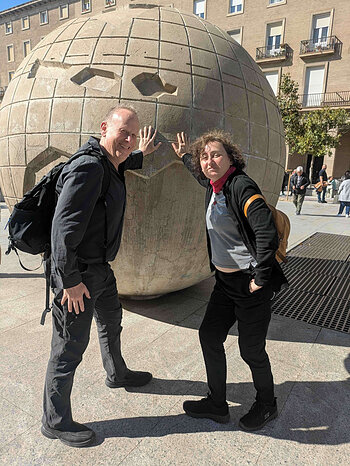
So when Cholak saw an opportunity via Notre Dame Global’s International Research Travel Grant to go to Spain to meet with Mayordomo in 2025, he took it. “The travel money got me to Zaragoza, which was great,” he says. “Just being there with Elvira made it easier to communicate and to move things forward,” he says. Their week working together in-person allowed them to add important detail and context to the proof, propelling the research project forward.
Beyond the research progress, Cholak also benefited from getting to experience his collaborator’s work environment. “It's great to see how other people live, what happens with other universities, how they interact with their students, and how other universities are set up,” he shares. And then there’s the social element—like going out for tapas at the end of a long day of research. For Cholak, spending that time together solidifies and improves their working relationship and results in smoother collaboration.
The International Travel Research Grant also funded Mayordomo’s visit to the United States for an in-person gathering in February of 2026, this time with multiple members of the research group in Chicago. “The opportunity to have additional in-person meetings with an international collaborator in the interim has been very important for maintaining the momentum of this ongoing collaboration,” Lutz attests. They used the time together to discuss revisions of their in-progress paper, as well as extensions and follow-up work. “Getting together is the glue that holds it together, and then the Zooms fill in the gaps,” adds Cholak.
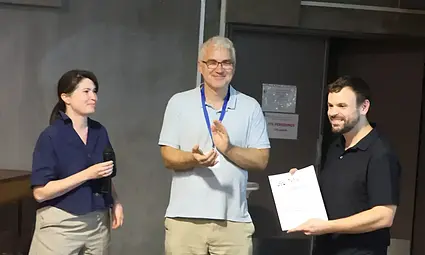
Their collaboration resulted in a published paper and an international award to top it off. This August, Lutz traveled to Paris for the Mathematical Foundations of Computer Science conference, where he gave two talks and accepted the Best Paper Award for their group’s research paper, Algorithmic Information Bounds for Distances and Orthogonal Projections.
While the award is certainly a highlight, both Cholak and Lutz agree that what their research group accomplished has great value, with or without it. “It's an exceptional case,” Cholak says. “But even without the Best Paper Award, I think the collaboration has been, in our eyes, very successful.” So much so that the group will continue to meet to finalize a second paper and look forward to reconvening in person again at the AIM conference in June 2027.
Learn more about the support Notre Dame Global offers for international research by visiting the Grants and Funding page on our website.
Originally published by at global.nd.edu on September 24, 2026.