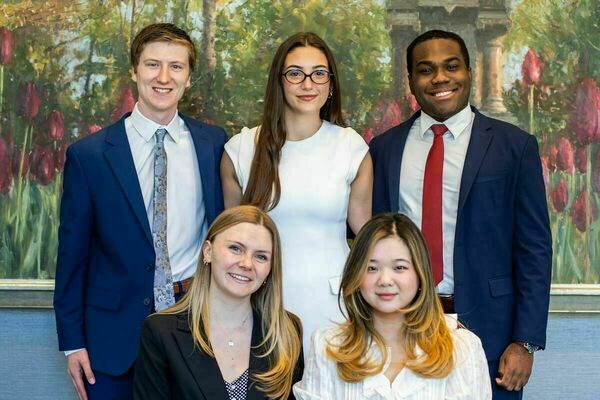
The University of Notre Dame team took top honors at the recent international Emory Morningside Global Health Case Competition. This year, the highly competitive annual competition included 31 teams from universities across the US and around the globe. This is the first time a Notre Dame team has won this competition since annual participation began in 2016. An honorable mention was earned in 2021.
The winning Notre Dame global health case competition team was made up of undergraduate students and included:
- Ivy Clark, ‘26, Neuroscience & Behavior
- Emma LeSieur, ‘28, English and Pre-Health
- Anesu Matara, ‘26, Physics in Medicine
- Owen McDonald, ‘28, Neuroscience & Behavior
In addition, Olivia Cai, '28, Finance and Philosophy, assisted the team in the competition's first round.
“At the Emory competition, there was a wide range of participants involved,” said Matara. “Seeing teams from schools and medical schools across the United States, in addition to schools in Canada, Australia, Uganda, and Malaysia, was truly inspiring. It was amazing to see how many people around the world share a passion and interest in global health.”
The Emory University event format consists of two rounds. The competing teams receive the case about one week in advance. In round one, all teams present their solutions to the case. The top five teams are then selected to move on to round two, where they are given a new variable in the case to apply to their prepared strategy. Then the final five teams present how they would address this new variable, and judges deliberate to determine the top solution. This year, the entire event was held virtually.
The case addressed by all teams competing at Emory was titled "Beyond Calories: Rethinking Food Aid in Crisis," and it was set in the fictional country of “Kifaru.” Each team was tasked with developing a humanitarian nutrition intervention spanning a five-year period, focusing on reducing reliance on ultra-processed foods and addressing the significant burden of malnutrition. The Notre Dame team was judged to have successfully addressed all issues.
“The most challenging aspect of this year’s case was that it wasn’t based on a specific country,” said McDonald. “This forced us to have a more general and less specific proposal, but we worked to address this by drawing comparisons to real-world countries.”
“While this was initially challenging, we ultimately found a silver lining in that it allowed us to spend more time focusing on the core issues of the case itself rather than getting caught up in contextual details,” added Matara.
“Another difficult aspect was limiting ourselves to a plan that was feasible and realistic,” said LeSieur. “In the realm of global health, there is a lot of room for innovation. But an innovation has to be balanced with cultural understanding, budget constraints, and other circumstances unique to the location where the intervention is based.”
She added, “And with twelve minutes to present, it was difficult to address everything we wanted to include.”

“The stellar performance of these undergraduate students, their hard work over the past several weeks, and their unwavering commitment to global health have been inspiring,” said Marian Botchway, assistant director of the Eck Institute for Global Health and faculty mentor for the team. “I am so proud of these thoughtful and passionate students.”
The road to victory began in February with the Notre Dame Global Health Case Competition, where 12 multidisciplinary student teams competed to become Notre Dame’s representative for the Emory competition. At this February contest, Victoria Gibek (‘28, Science Preprofessional Studies and Global Affairs) was also a member of the winning team. However, due to a schedule conflict, she was unable to participate in Emory’s competition.
The annual Notre Dame event and participation in the Emory event are organized by the Eck Institute for Global Health under Botchway’s leadership. While some teams for the Notre Dame competition form themselves, and she assembles others from individual registrants, all teams must include four to six students from at least three different colleges or schools to integrate multidisciplinary teamwork and perspectives in addressing global health challenges.
LeSieur noted, “I recommend joining a random team for the first year. The best solutions come from collaboration between people from different educational and personal backgrounds.”
“As a finance major, I felt that I was able to provide recommendations and solutions from a different angle and perspective, aiding in the success of the team,” said Cai.
“Last year, Ivy [Clark] and I were part of the team that advanced to the Emory competition,” added McDonald. “After participating in that competition, we saw what it took to be successful, and the two of us had a strong feeling that if we were able to come back next year, we could be very competitive.” McDonald and Clark joined forces with LeSieur and Matara, also finalists at Notre Dame’s competition in 2025.
“This is my fourth year competing in the Notre Dame Global Health Case Competition and my second year competing in the Emory event,” said Clark. “My favorite part of this is the ability to apply concepts we have learned about in coursework to real-life scenarios in new and innovative ways.”
She continued, “Three of our five team members are pursuing a Minor in Global Health, and most of us came with a lot of background knowledge from various classes and extracurriculars. Being able to combine that knowledge to come up with a novel approach to a global health issue is so rewarding.“
To learn more about education opportunities in global health, please visit the Eck Institute for Global Health website: https://globalhealth.nd.edu/education/
Contact:
Damienne Jugovic, Research Communications Specialist
Notre Dame Research / University of Notre Dame
djugovic@nd.edu
research.nd.edu / @UNDResearch
About the Eck Institute for Global Health
The Eck Institute for Global Health, an integral part of Notre Dame Research, builds on the University’s historical strength in infectious disease research, including vector-borne diseases, while broadening the interdisciplinary expertise into other key global health areas including non-communicable diseases; maternal, newborn, and child health (MNCH); and global health security. The Eck Institute recognizes health as a fundamental human right and promotes research, training, and service to advance health standards and reduce health disparities, especially for those who are disproportionately impacted by preventable diseases. The Eck Institute is training the next generation of global health researchers and leaders through undergraduate, masters, doctoral, and postdoctoral programs.
Originally published by at globalhealth.nd.edu on April 08, 2026.